
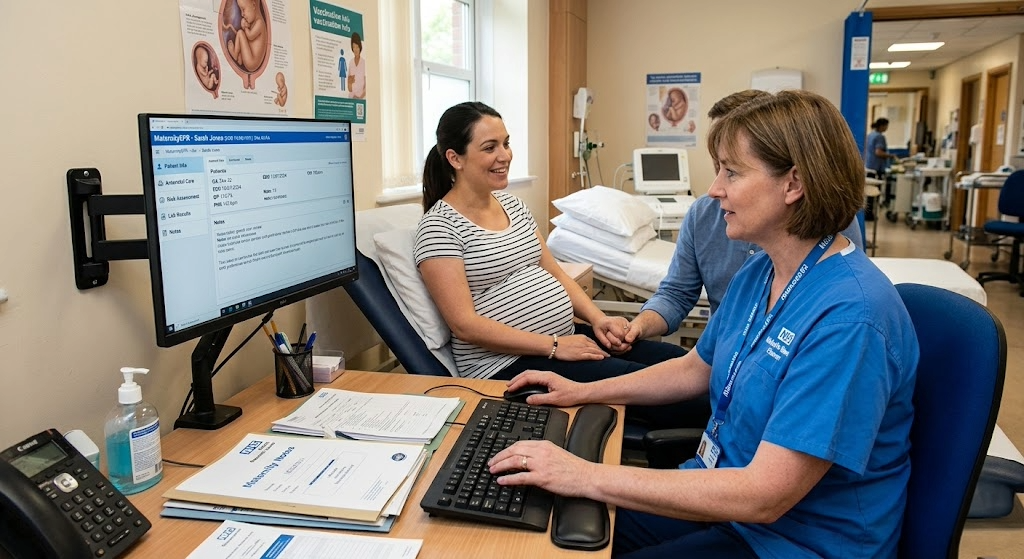
Elevating Maternal Insight with a Dedicated Maternity EPR
A dedicated Maternity EPR is quickly becoming a core element of safer maternity care across NHS trusts, community services, and private healthcare providers. When clinical data is captured, interpreted, and shared digitally, midwives and obstetric teams gain a clearer, more timely picture of an expectant mother’s health. This supports better decision-making, earlier intervention, and more consistent support for both mother and baby.
Traditional hand-held paper notes have served maternity units for decades, however increasingly Trusts are shifting towards digital under the demands of modern multidisciplinary care. A dedicated Maternity EPR helps organisations move from isolated records and manual calculations to structured, reliable information that can travel with the patient across every stage of the clinical pathway.
At Harlow Solutions, this shift is supported through the provision of digital infrastructure, specialist healthcare software, and support that keeps maternity monitoring accurate and operationally resilient at scale.
Digitisation of maternity patient records means that outliers and high-risk patterns are identified earlier and more consistently. Instead of relying on manual data entry and delayed face-to-face reviews, digital systems instantly highlight critical changes in blood pressure, foetal movement, or blood glucose levels that may signal complex needs or emergency interventions. This is particularly important where mothers are seen by multiple teams, including community midwives, acute obstetricians, and specialist endocrinologists.
Harlow Solutions, as a family-owned provider based in the UK, works with public sector organisations to support these complex workflows. By providing digital infrastructure tailored for maternity units, clinical data can be captured once, interpreted consistently, and shared safely, even where hospitals operate in mixed digital and paper environments.
The Evolution of Traditional Maternity Workflows
Paper-based maternity patient records have long been the trusted foundation of clinical care. However, as maternity pathways become increasingly multidisciplinary, spanning community clinics, hospital wards, and the patient’s own home, maintaining a single, comprehensive view of a pregnancy using physical notes becomes highly complex.
As clinical demands grow, Trusts are naturally looking for ways to streamline processes and address common logistical challenges, such as:
- The physical coordination of sharing records across multiple healthcare sites
- The time required for manual transcription during complex patient handovers
- The necessity of ensuring physical notes are always present at the exact point of care
- The administrative effort required to consolidate data for Trust-level reporting or clinical audit
Administrative and clinical staff dedicate significant time and care to managing these established workflows. They copy charts, physically transport files, and manually enter measurements into broader hospital systems. As busy maternity units handle larger volumes of daily appointments, streamlining these manual steps presents a major opportunity to improve clinic throughput and ease the daily workload of front-line staff.
Governance and auditing are also areas where digital transformation offers clear, supportive advantages. While traditional records are maintained with immense dedication, digital records make it much simpler for Trusts to ensure:
- Clear, automated audit trails of access and clinical changes
- Instant version control for updated birth plans or corrected medical entries
- Consistent information governance across multiple integrated hospital sites
- Immediate visibility of records, removing the worry of files delayed in transit
When care teams have instant, unified access to maternity patient records, they can make critical decisions with total confidence. They no longer need to spend valuable time reconstructing medical histories from partial files. This seamless access perfectly aligns with the expectations of modern clinical governance and supports the rigorous safety standards required in today’s maternity care.
Inside a Modern Digital Maternity Ecosystem
A mature digital Maternity EPR ecosystem goes far beyond a scanned digital maternity record. It is built on structured, clinically meaningful data captured at each contact and immediately available to authorised teams. Automated risk assessments and real-time data syncing help clinicians interpret health indicators quickly and consistently, without manual cross-referencing.
Key characteristics of such an ecosystem include:
- Structured entry of vital measurements such as blood pressure, fundal height, and glucose readings
- Automated use of appropriate clinical pathways based on individual patient risk factors
- Configurable alerts for sudden symptom changes or missing routine data
- Longitudinal reporting across the entire antenatal, intrapartum, and postnatal journey
Specialised platforms such as MiRecord are designed directly to support maternity pathways, allowing mothers to seamlessly log vital data, such as gestational diabetes readings, straight from their mobile devices. These systems help coordinate information between the home and the hospital while keeping specific maternal data aligned with wider clinical documentation.
Integration is absolutely central. Secure links with existing Trust EPRs and Patient Administration Systems mean that a Maternity EPR is not trapped as a standalone application. Instead, it forms part of a coherent clinical record. Harlow Solutions provides the underlying digital and operational infrastructure so that these integrations remain stable and resilient, ensuring zero friction for the end user.
Safeguarding, Accuracy, and Governance by Design
A Maternity EPR significantly improves accuracy on the ward. Validated algorithms and automated flagging reduce the risk of misread charts, transcription mistakes, or overlooked lab results. Trends such as gradual changes in maternal health are far easier to identify when presented visually in a consistent, unified format.
This accuracy has direct implications for clinical safeguarding. Maternity data can be:
- Flagged immediately when it deviates from expected healthy patterns
- Combined with other clinical, historical, and social indicators
- Reviewed rapidly in multi-agency meetings with a shared, up-to-date reference point
Role-based access controls mean that only appropriate medical professionals can view or edit specific information. Audit logs record exactly who accessed which records and when, supporting both clinical governance and strict information governance. Structured documentation pathways support the consistent recording of concerns, clinical decisions, and postnatal follow-up plans.
Platforms designed for maternity can be positioned securely within broader clinical governance frameworks. When configured and deployed effectively, they help NHS organisations meet expectations from regulators and system-level bodies, including:
- Support for consistent documentation and review of maternal and foetal data
- Reliable input into integrated care system reporting
- A stronger basis for population health analysis and regional service planning
By embedding a secure Maternity EPR into wider governance structures, organisations can be completely confident that their maternity monitoring is not only clinically effective but also procedurally sound.
See Your Maternity Pathways Clearly With Modern IntegrationIf you are ready to replace fragmented workflows with clear, visual insight, the MiRecord platform provides the precise view of patient health your Trust needs. At Harlow, we work directly with you to define the clinical metrics that matter most. We then deploy MiRecord as a straightforward, secure system your entire team can rely on to drive maternal safety. Share a few details about your digital roadmap, and we will recommend a practical, fully compliant way forward. To discuss your clinical transition, simply contact Harlow today.